

The Power of Youth Movements Past and Present: Investigation in a Serbian Context
Abstract
The 2024 Novi Sad mobilization in demand of justice for 15 civilians who tragically lost their lives to a collapse in infrastructure evolved into a globally-recognized movement against corruption, authoritarian populism, and media control in Serbia. By contextualizing this movement with the Serbian student protests of the early 1990s, the power of youth as collective agents for positive change and societal progress is emphasized and understood; unfortunately, the limitations faced by student movements, both historically and today, are revealed as well. By revisiting the successes and pushbacks to movements of the past, student activists globally, and those simply striving for a better world, can find themselves with newfound motivation, strategy, and, most importantly, hope.
Background to Protests in Serbia
In November of 2024, a railway station roof collapsed in the Serbian city of Novi Sad. This tragedy led to the death of 15 people, as well as thousands more taking to the streets in their honor, demanding justice and change. At first, the movement lacked widespread popularity beyond student populations. Still, over time, it evolved to encompass much of civil society and a historic series of political events lasting over 7 months. Roads were blocked, public spaces were taken over, and university faculty buildings were taken over.
While this tragedy in Novi Sad may, at first glance, seem like an unfortunate accident, to a notable number of Serbian students it represented the culmination of decades-long battles against local and state corruption and nepotism, as they believed those hired for the project were not chosen solely based on competence.
A sizable portion of youth, as well as the general Serbian population, has long opposed what they believe is autocratic rule since President Aleksandar Vucic came to power over a decade ago. They are not necessarily calling for his removal from power, but rather for fair elections, the end of state corruption, free media, an unbiased press, and general democratic values.
Painting their hands red to represent the blood on the government’s hands, what began as a call for justice and support for victims has led to the halting of classes, students sleeping in lecture halls, a global eye on the future of Serbia, and most notably, a lasting legacy of the power of youth. This movement is not the first widespread youth protest movement in Serbia, and is especially far from the first globally. Rather, it has joined a long-standing history of the influence and power that citizens can wield when united, particularly concerning students.
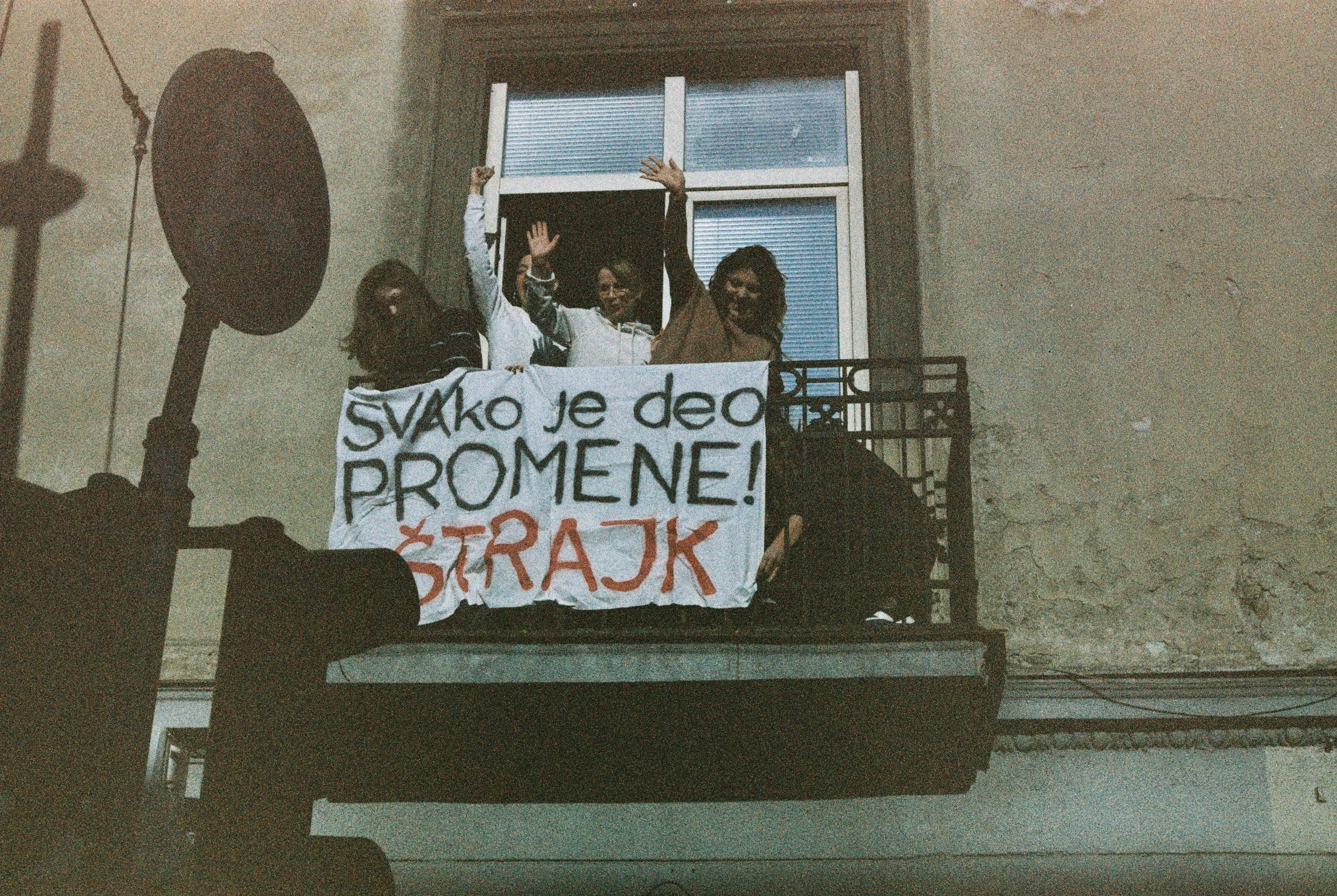
Three protestors on a balcony hold a sign supporting change, symbolizing unity. Source: Branka Krnjaja from Pexels
Historical Student Movements in Serbia
In 1992, the dissolution of Yugoslavia was, in part, contingent on the rise of an ethnonationalist and authoritarian Serbia. Yet, this was a state-led political shift not necessarily accepted by all citizens. In June of that year, with the start of the Yugoslav war, the University of Belgrade saw a 26-day protest that included forms of civil disobedience and the occupation of university buildings. Students took turns patrolling their spaces, organizing lectures with volunteers, and holding meetings on how to further their movement.
They particularly focused on the problem of state-controlled media, considering how to access independent and supportive journalists to promote their cause, as well as fighting a media brigade and government propaganda, similar to the protests in Serbia in 2024-2025. Helping them was the community: the elderly bringing fresh food, civilians donating to support students with no income, and many professionals from a wide variety of fields joining their lectures and discussions.
Implications and Effects
One factor was crucial in ensuring the impact of student protests in the 1990s throughout Serbia: citizen support. As was mentioned, all ages and sectors of the Serbian civilian population came together to aid youth in their mission, by providing necessary goods such as technology for 24/7 radio broadcasts, rock groups coming in to perform in hopes of boosting moral, and even an older gentlemen in folk clothing delivering a lamb roast, shared by Prosic-Dvornic and shared through a series of interviews.
Noting that the Yugoslavian civil war began in 1992 and was in significant part pushed by ethno-nationalism, there is no doubt that mass media abused ethnic identities to paint protesters in a negative light and even pin them against each other. Discussions of the crimes and genocidal violence committed against the Bosnian people by Serbian forces were of great debate among not just the students but members of civil society participating in lectures, debates, and organizational assistance. While elements of this tension are unique to the Balkan region, the general notion that historic ethnic, religious, and national identities limit social change is a significant barrier to progress that many youth face today, and something they did not choose nor orchestrate themselves.
As Prosic-Dvornic put forward in her qualitative research, comprising interviews and personal experience, both the mass media and major politicians often questioned the Serbian identity of highly publicized student organizers and the professors assisting them, as a strategy to limit nationwide support. This is not to say that the students’ movement was supported by all, with older civilian critics claiming that "nothing should or could change…You are young, don't be fainthearted. There will be jobs and apartments. You can't have everything at once…We didn't have anything in our youth either, so what?"
Conclusion: The Power of Youth
Building on the previously shared limitations, barriers, and critiques faced by the student movement in Serbia of the 1990s, it is seen that many youth movements of today share similar pushback– that of doubt, of a forced acceptance of how things are by older generations. Yet many students and young professionals today refuse to accept the felt and lived flaws of a world not chosen. Political manipulation of diversity, intensely nationalistic right-wing political trends, and a battle against the media may feel familiar to many student protestors, organizers, and activists globally; each fighting for their respective causes, which are different sides of the same coin.
As students globally find their footing, navigate these limiting beliefs, and balance education, work, and future careers, it can often be difficult to keep faith and move forward in hopes of social change. Yet there is much to be learned from the stories of those who came before us, who fought similar battles, as well as from finding global connection and support. Something the youth of today has that no other generation has had before is the promise of instant international connection. Reach out, find those in different contexts with the same challenges, and the students of today can certainly succeed in securing a stronger future.
Recommendations
Shift understanding of youth activism: Students and younger generations as a whole, beyond the Balkan context, are crucial agents of social change, yet their strength and influence have long been reduced and ridiculed by older politicians and conservative members of society. Often, youth have to prove themselves as worth listening to, as educated, as valuable; rather than these traits being seen as intrinsic to them. Knowledge from experience is just as, if not more, necessary as knowledge from further formal education or work environments. Hence, youth participation in inclusive dialogue for social change should become the norm.
Reduce bureaucratic barriers of legitimacy for youth movements: International Organizations, in particular, must give greater recognition to youth organizations, especially in the context of actors in civil society, and give more than just one seat at the table to listen. Youth groups must be seen as what they are: legitimate actors pushing and influencing political change both in their respective home countries and globally.
Support local youth movements: A big part of what made the student protests in Serbia so notable is the eventual inclusion of other groups and generations. For all generations in all regions of the world, support your youth. They are the next leaders and deserve recognition for their passion and hard work!
Bibliography
Beširević, Katarina. "“Nisi nadležan”: How a Student Movement Dictates Political Change in Serbia (2024/2025)." Contemporary Southeastern Europe 12.1 (2025): 30-38.
Prosic-Dvornic, Mirjana. "Enough! Student Protest '92: The Youth of Belgrade in Quest of "Another Serbia"." Anthropology of East Europe Review 11.1 & 2 (1993): 127-137.
Prosic-Dvornic, Mirjana. "The topsy turvy days were there again: Student and civil protest in Belgrade and Serbia, 1996/1997." Anthropology of East Europe Review 16.1 (1998): 120-151.
Sekularac, Ivana, et al. “How Serbia's students turned tragedy into a national movement for change.” Reuters, 14 February 2025, Accessed 9 June 2025.
“Serbia's protesting students rally to mark 7 months since train station tragedy.” Newsday, 2 June 2025, Accessed 9 June 2025.