


Who We Are
We are a global movement of young people led by young people for young people.
Our Founding Logic
The dominant international peace and security structures were built without the participation of the Global Majority and without young people. Institutions that directly counteract this imbalance are desperately needed. Founded on the principles of decolonization, localization, and youth leadership, Youth Transforming Narratives exists to challenge the inherited inequality in global governance and to transform the institutions maintaining that imbalance.
Meet YTN
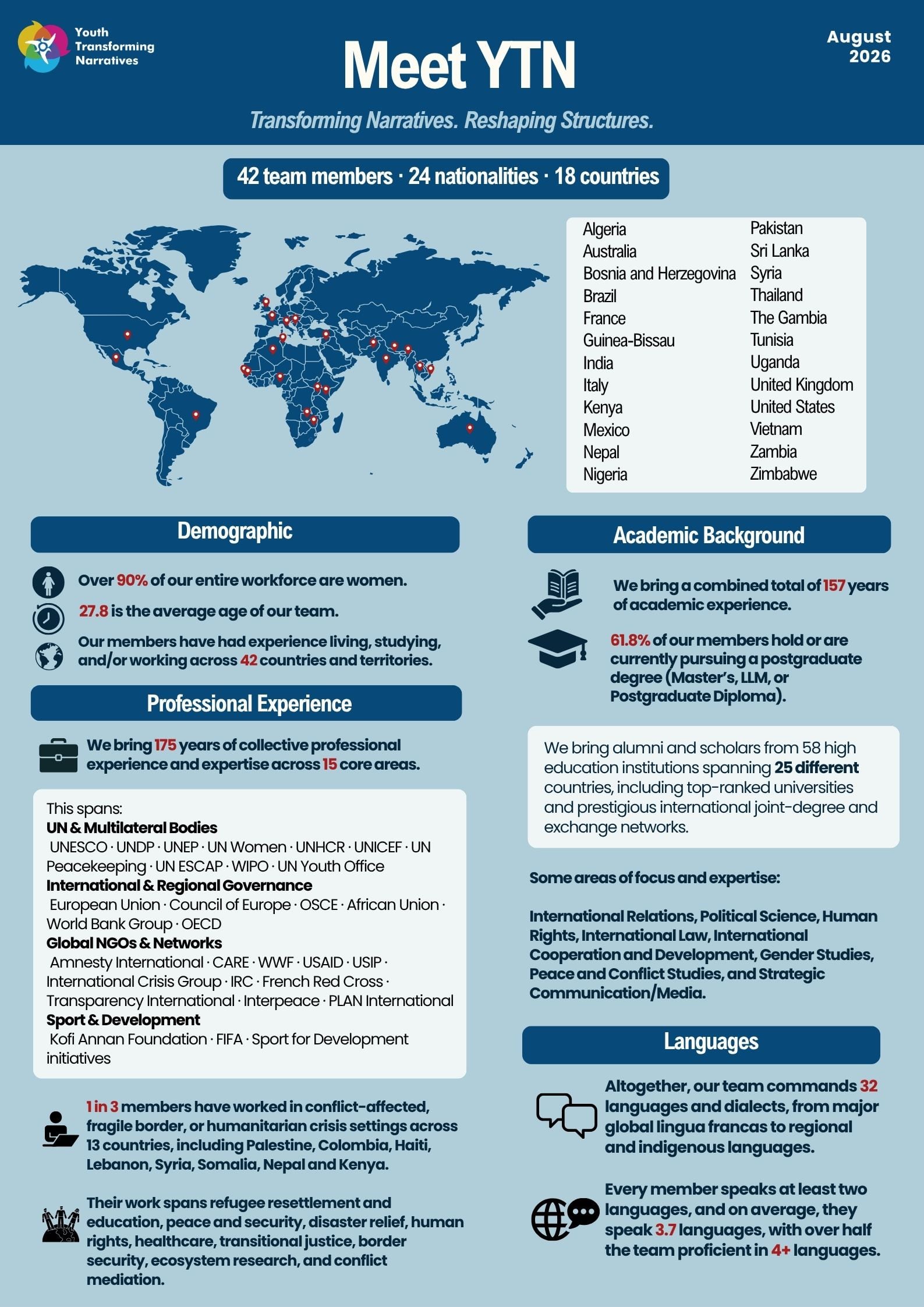
Who we are in one page: our team, where we come from, and the experience we bring (August 2026).
Read it as text
- 42 team members, 24 nationalities, based in 18 countries.
- Over 90% of our entire workforce are women, and 27.8 is the average age of our team.
- Our members have lived, studied or worked across 42 countries and territories.
- We bring 175 years of collective professional experience across 15 core areas, spanning UN and multilateral bodies, international and regional governance, global NGOs and networks, and sport and development.
- 1 in 3 members have worked in conflict-affected, fragile border or humanitarian crisis settings across 13 countries, including Palestine, Colombia, Haiti, Lebanon, Syria, Somalia, Nepal and Kenya.
- We bring a combined 157 years of academic experience; 61.8% of our members hold or are pursuing a postgraduate degree, from 58 institutions in 25 countries.
- Together we speak 32 languages and dialects. Every member speaks at least two, and on average 3.7.
Our Work Pillars
Research and Knowledge Production
Through our Research Team, we conduct original studies, collect data, and analyze trends in youth in peace, security, and decolonization efforts to rewrite the narrative of knowledge production and promote a more inclusive and diverse global discourse on youth empowerment, decolonization, and peacebuilding.
Capacity-Building Programs and Initiatives
To overcome the dominant narratives of imbalance and futility, young people must be equipped with the right knowledge and tools to push for change in this generation. Through initiatives like our Community of Practice and our seminar series, YTN designs and delivers programs aimed at empowering young people with the resources they need to be effective leaders and drive positive change in their communities.
Advocacy
Advocacy initiatives are critical to driving systemic change by influencing policies, mobilizing support, and raising awareness about issues related to peace, security, and decolonization. Using digital platforms and resources, our Advocacy team drives these initiatives by developing relevant campaigns, engaging with stakeholders, and raising public awareness of the world’s most pressing issues.
Community-Building
Cultivating safe, inclusive, and open digital spaces for youth to engage with one another is crucial to fostering a genuinely connected and genuinely global youth movement. Through initiatives like our Community of Practice and our UN Working Group on Decolonisation, we encourage national, regional, and international networking among our participants, and foster solidarity and the exchange of ideas among youth from around the world.
Influencing Policy Through Intergenerational Dialogue
Facilitating intergenerational dialogue is the key to ensuring that youth perspectives can cross the gap between advocacy work and policy change. Through our Policy team, YTN not only focuses on translating research findings into actionable policy recommendations, but also on preserving the element of youth perspectives by intentionally engaging with global stakeholders through mediums such as international conferences.
Youth, Peace and Security
UN Security Council Resolution 2250 on Youth, Peace and Security (2015) recognizes the vital role young people play in building and sustaining peace, and we see YTN as a key player in the Agenda. Through the efforts of our YPS team, we seek to establish cross-sectoral partnerships to promote the Agenda while highlighting the gaps in the existing Resolution’s framework, particularly regarding adapting its implementation to better reflect the lived realities of those in Global Majority nations.