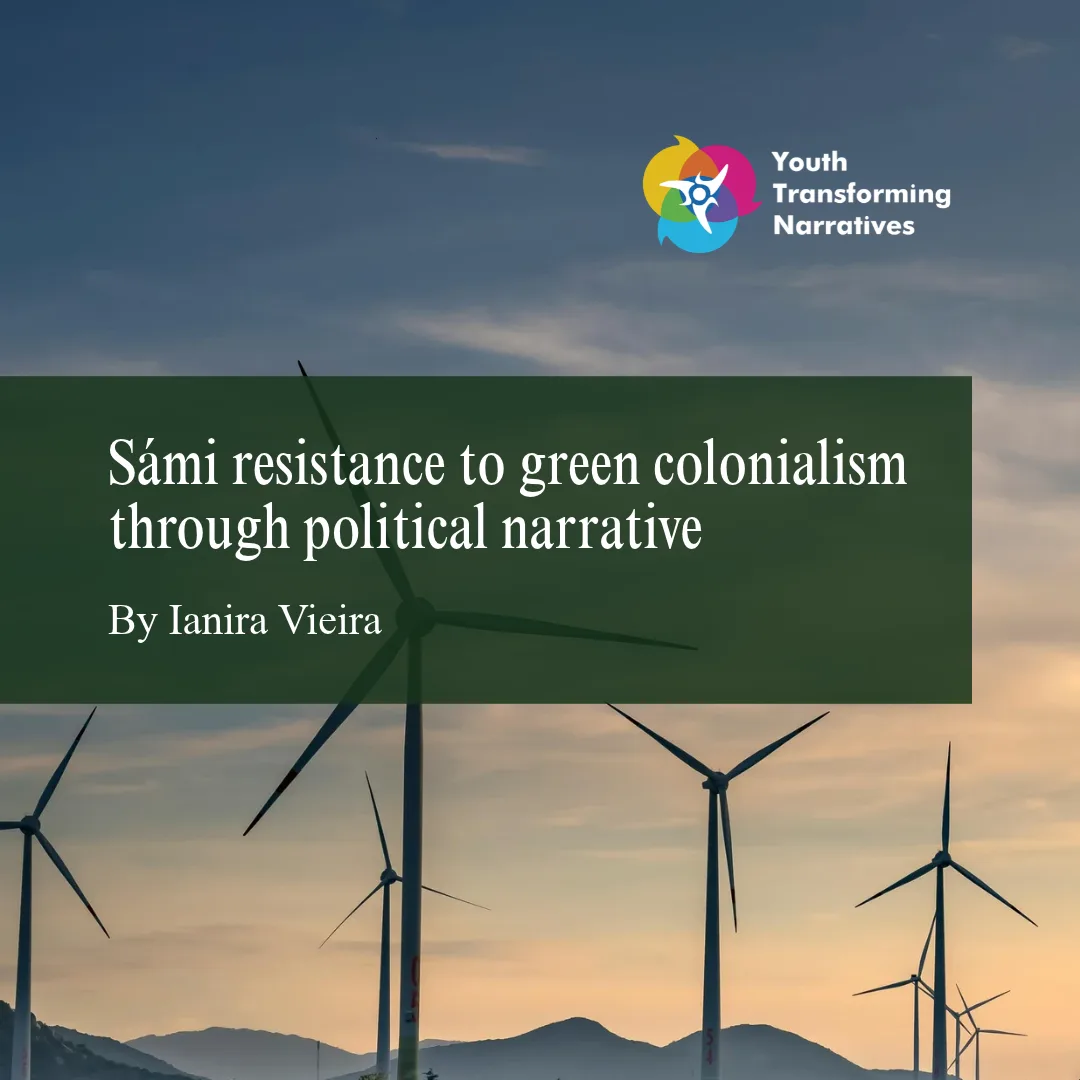
On 11 October 2021, Norway's Supreme Court unanimously ruled that the licenses for the Storheia and Roan wind farms on the Fosen peninsula were invalid because the projects violated Sámi reindeer herders' rights to preserve their culture.
Although the ruling was a historic victory for Sámi rights in the courts, the turbines are still operating five years later. After the ruling, the state did not order the turbines removed. Instead, it entered into separate negotiations with two affected herding communities, each of which received a different compensation package.
Sámi leaders and activists, most prominently former Sámi Parliament President Aili Keskitalo, have called the recent wave of dispossession “green colonialism”. Kårtveit (2021) describes the term as a political narrative that connects today's opposition to wind power megaprojects to earlier land losses and the struggle for Sámi rights.
Apart from mobilizing resistance, the political narrative of green colonialism also helps explain why the demands keep falling on Sápmi. And the answer comes down to how law and policy have defined the territory for a long time.
The Sacrificial Lamb
Colonial practices have limited the extent of Sápmi to the areas currently used for reindeer grazing, obscuring the territory's historical boundaries. As grazing land is used seasonally and collectively, it usually does not come with a property title that developers, states, or courts tend to recognize, especially within nation-state and capitalist structures. This means it can be described as “unused”, even when it is the winter pasture a herding community depends on for survival. The Fosen case illustrates this clearly.
This is reinforced by a long history of describing Sápmi as a periphery and its people, culture, and history as primitive and inferior. From this framing, the territory is easier to treat as expendable, and Sámi objections are easier to dismiss as obstacles to progress, rather than demands from rights holders.
Megaprojects such as wind energy in Sápmi need this framing. These projects require vast areas, and sparsely populated regions offer them low political cost. The benefits, such as clean energy for national grids and European climate targets, can be claimed to extend nationally or even continentally. The costs, such as land fragmentation, the disruption and damage to Indigenous cultural practices and sacred sites, however, remain localized.
Moreover, Sápmi has already been exploited in this way. Hydropower stations, roads, power grids, and military facilities have already been built there, so every new project can be presented as an addition to something that already exists. This hides the cumulative effect. Dispossession happens again and again, and each impact is assessed on its own.
Free, Prior, and Informed Consent
Norway was the first country to ratify ILO Convention 169, which recognizes Indigenous peoples' right to Free, Prior and Informed Consent (FPIC), meaning the right to give or withhold consent. In practice, however, this is replaced by the language of “dialogue”, in which developers and state authorities use consultation to claim that Sámi communities were "involved". Kårtveit (2021) argues that the language of "dialogue" hides imbalance of power and resources between communities and developers.
In many cases, Sámi communities clearly state their concerns and opposition, yet projects proceed anyway. The Fosen case is an example of this practice. Hearings were held and written input was accepted, so on paper the community was "involved." But the relational Sámi understanding of the landscape did not enter the environmental impact assessments. Construction began in 2016, after the state granted early construction approval in 2014, despite Sámi communities challenging the licenses through every level of the Norwegian court system, and even though UN bodies called for the project to be suspended in December 2018, construction continued. In summary, the “consultation” took place, but the community's objection carried no binding weight.
If consultation without consent produces this outcome, the alternative is to make consent binding. In 2025, after a visit requested by the Saami Council, the UN Expert Mechanism on the Rights of Indigenous Peoples (EMRIP) published a report with recommendations to strengthen the rights of the Indigenous Sámi People in Norway. During the visit, the experts met with several stakeholders, including rights holders, businesses, Sámi organizations, the Norwegian National Human Rights Institution, and several ministries.
Among other recommendations, it was urged that Norway should abolish the pre-permitting practice, which allows construction to begin before legal challenges are settled; implement the Sámi people’s right to Free, Prior and Informed Consent in the Sámi Act, the Minerals Act, energy legislation and the Planning and Building Act; grant Sámi rights holders the same veto power over wind power projects as municipalities currently have; require free, prior and informed consent during environmental impact assessments and in the selection of assessors; and establish a body to monitor compliance with court decisions.
If implemented, this would also change the incentives. If a "no" carries legal force, developers will stop treating consultation as a mere formality to be completed before construction.
The Solution is Decolonization and Localization
Beyond the measures recommended by EMRIP, decolonizing the green shift starts with changing the legal terms of who owns and who decides.
Decentralized, democratic solutions should be considered as an alternative to the megaproject model, since local ownership keeps benefits and decisions closer to those affected.
In this case, as Amnesty International and Saami Council (2025) argue, paths to just transitions would require Free, Prior, and Informed Consent (FPIC) as a binding legal condition for every land use decision in Sápmi, as well as guaranteed resources for meaningful Sámi participation in consultations, the integration of Sámi traditional knowledge into impact assessments, and the legal recognition of Sámi objections that national states should observe.